Showing posts with label Argentina. Show all posts

Sunday, 24 July 2011

Copa América review: COSTA RICA

Now to the fourth and last of the sides eliminated at the group stage, the second invitee from the CONCACAF region, COSTA RICA.

As guests, Costa Rica, like Mexico, brought their Olympic squad with under-23 players to this tournament. Along with that, twelve of this Copa América squad were members of the Costa Rican party that participated in the 2011 Gold Cup in the United States the month before.

Without many high expectations weighing them down, this youthful Ticos side gave a great account of themselves, narrowly missing out on qualifying for the knockout stages. In Group A alongside Argentina, Colombia and Bolivia, they managed three points in a 2x0 win over Bolivia, a result which was sandwiched in between a tight 1x0 loss to Colombia and a rather humbling 3x0 defeat at the hands of hosts Argentina.

One of the more intriguing elements to consider regarding this Costa Rican side was their unorthodox and exciting tactics. With eccentric Argentine coach Ricardo La Volpe on the sidelines, enthusiasts have learned to expect the unexpected and in his bizarre 3-5-2/3-3-4 system, el Bigotón ('the Moustache') certainly delivered.

The system is probably best defined as a 3-5-2, but there are a number of quirks in its application that make it very different. The main source of confusion is the role of the left-sided player, usually Cerro Porteño's Diego Madrigal. In a standard 3-5-2, Madrigal would be the left wing back, sitting a little higher than the centre back line and attacking when the opportunity presented itself (like the right-sided Salvatierra). However, Madrigal's position approached that of a forward's, as he was often the highest player up the pitch but still made big retreating runs back to defence. Another important aspect is the forward runs of the midfielders, but we will go on to discuss that very shortly.
La Volpe's 3-5-2
In their opening match against Colombia they found themselves in trouble very early on, as their captain Randall Brenes was sent off within the first half hour. Colombia then took the initiative and made a tactical switch which really exploited their man advantage. Los Ticos struggled to deal with the alteration and fell a goal behind, but still managed to play a solid game for the rest of the ninety minutes, not conceding more than once.

In their next match against Bolivia, their unconventional system worked perfectly as they brushed off la Verde 2x0. Forward Joel Campbell dropped deep and worked in the channels where he was offered a lot of space. The forward runs from the midfielders (particularly substitute Guevara in the second half) were left largely untracked, and it resulted in Costa Rica having four against four in attacking situations.

Animation of Costa Rica moving into an attacking phase. Note the four defenders having to deal with the four attackers. (CLICK TO PLAY ANIMATION)
In their final game against Argentina, La Volpe attempted to play a little more cautiously against the country of his birth, but their lop-sided and disorganised shape left them exposed and they were picked apart by Lionel Messi. The best player in the world had a delightful match, picking out countless perfect passes to his team-mates as Argentina strolled to a 3x0 victory.

With three points from three games leaving them in third place in Group A, Costa Rica had to rely on results in the other groups to go in their favour to have a chance of qualifying. Unfortunately for Los Ticos, the match between Paraguay and Venezuela finished as a draw, leaving Costa Rica as the worst third-placed team and thus eliminating them from the competition.

Despite the early exit, this was certainly a positive performance from Costa Rica in this year's Copa. One of the main plus points was the continued emergence of young forward Joel Campbell of Saprissa. With the sending off of team captain Randall Brenes in their first match, Campbell took on the job of being Costa Rica's main attacking threat. He impressed throughout the three matches, particularly against Bolivia where his direct dribbling, pace and trickery was a constant thorn in the side of la Verde.

All things cAfter the match against Bolivia, Campbell was subject to interest from some of Europe's biggest clubs, with Arsenal reportedly agreeing a transfer worth around $1,5million. However the move broke down, with Campbell himself stating that he did not want to sign with Arsenal at the present time, believing his own stock will rise further after the upcoming 2011 Youth World Cup. The 19 year-old was the only member of the Costa Rican national pool who played at the Gold Cup, then in this Copa América and now is in the squad for the youth tournament in Colombia.

Saturday, 23 July 2011

Copa América review: BOLIVIA

Continuing on with my series of nation-by-nation reviews, we move on to this year's 11th ranked side, BOLIVIA.

Ranked 93rd in the world and without a win away from home since 2007, no-one was really expecting much from Bolivia in this Copa América. Furthermore they were drawn into Group A alongside Argentina, Colombia and Costa Rica, and even given the 'honour' of playing the hosts in the tournament's opening match. In the end they only managed to register a paltry one point, but that certainly does not tell the full story of their campaign.

The manager Gustavo Quinteros - a member of the Bolivian team when they last qualified for a World Cup in 1994 - selected a well-balanced and experienced 23-man squad, with only five of them playing their club football outside of Bolivia. La Verde shocked everyone when they managed to draw 1x1 with Argentina in the tournament's opening match, but they later succumbed to two 2x0 defeats against Costa Rica and Colombia. 

Tactically Quinteros had Bolivia set up in a very simple fashion, a defensive 4-4-2 with two solid banks of four playing behind the forwards. Their style worked superbly against Argentina's 4-3-3 in the first game, but struggled in the other two games when they were expected to play more football.

Against Argentina, Bolivia were excellent, staying compact and narrow and giving nothing away to Argentina's jewel-encrusted forward line. Team captain Ronald Raldes in particular gave a fabulous performance in the centre of defence; constantly spurning the hosts' attacking advances.
Line-ups vs. Argentina. (Note Bolivia's two narrow defensive lines, congesting the play and frustrating their opponents)
Bolivia took a surprise lead at the start of the second half when Argentina's Éver Banega let a back heel from Edivaldo Rojas sneak under his foot and roll into the net, and at that moment it looked like la Verde might manoeuvre a famous victory in La Plata. Their defence remained resolute, but eventually they conceded an equaliser through a stunning volley from substitute Sergio Agüero.

The script was quite different for their next match against Costa Rica, as Bolivia were coaxed into opening up and trying to win the match. They lined yp with a 4-4-2 again, but against Costa Rica's unorthodox 3-5-2/3-3-4 formation they ran in to real problems. This game will be discussed further when we cover Costa Rica, but essentially Bolivia's rigid shape struggled to deal with Costa Rica's fluidity and they found it hard to track the forward runs of the Costa Rican midfield.

Bolivia ended up losing the match 2x0, and things got even worse with the sending off of both Ronald Rivero and Walter Flores. This left la Verde needing a win in their final group match against the impressive Colombia to retain any chance of qualifying.

In that match against los Cafeteros in Santa Fe, Bolivia fielded a partially changed side due to the suspensions to Rivero and Flores. Santos Amador and Ronald García filled in at central defence and central midfield respectively, while there was a change at full-back, Christian Vargas coming in to replace Gutiérrez.

Bolivia looked to try and stay narrow like against Argentina, but Colombia's rampaging full-backs made that impossible, leaving the Bolivia defence stretched and full of holes. Colombia's wide midfielders Ramos and Moreno were happy to stay more central and occupy the Bolivia full-backs, which left Colombia's full-backs Armero and Zúñiga with the entire flank to operate in.
Formations vs. Colombia [Note how Vargas (14) and Álvarez (4) are occupied, allowing Colombia to control the flanks]
Despite this obvious advantage down the flanks for Colombia, the first goal went in courtesy of a through ball through the centre of the Bolivia defence. Lacking the regular partnership of Rivero and Raldes, Bolivia looked shaky and disorganised, and a well-timed run from Falcao left him clear on goal and allowed him to finish well.

The second goal however, was a prime example of Colombia's dominance on the wings. Pablo Armero made a huge run down the left flank, burst into the area and was tripped for a penalty. Falcao coolly dispatched the spot-kick and Bolivia were well and truly sank.

Looking back on the tournament, the Bolivia squad and staff will probably be quite disappointed. Despite punching considerably above their weight with their performance in the opening match, they still finished fourth in the group and only managed to score one goal. However there were certainly some huge positives to take from the tournament, namely the draw against Argentina in front of a capacity crowd in La Plata.

Now Bolivia will have their eyes on the 2014 World Cup qualifying, where they will attempt to pull off a few more famous results. At home in La Paz, they are capable of beating any opposition, but their main focus will be to improve their dreadful away record.  

Friday, 1 July 2011

Copa América at a Glance: ARGENTINA

Writer’s note: This mini-series is essentially just sulf-indulgence/Copa América excitement. Tactics are not my specialty, and I do not claim to be a tactics expert. Take these articles for what they are, some information, a couple of observations and some nice visual aids.

First of all, let’s have a look at the hosts Argentina. With Sergio Batista they have evolved from their tactically naïve 4-4-2 used at the World Cup to a more rational and functional 4-3-3, based on Barcelona’s style (I explain this transition here). The main aim of this formation, as has been mentioned several times previously, is to try and get the best out of Lionel Messi.


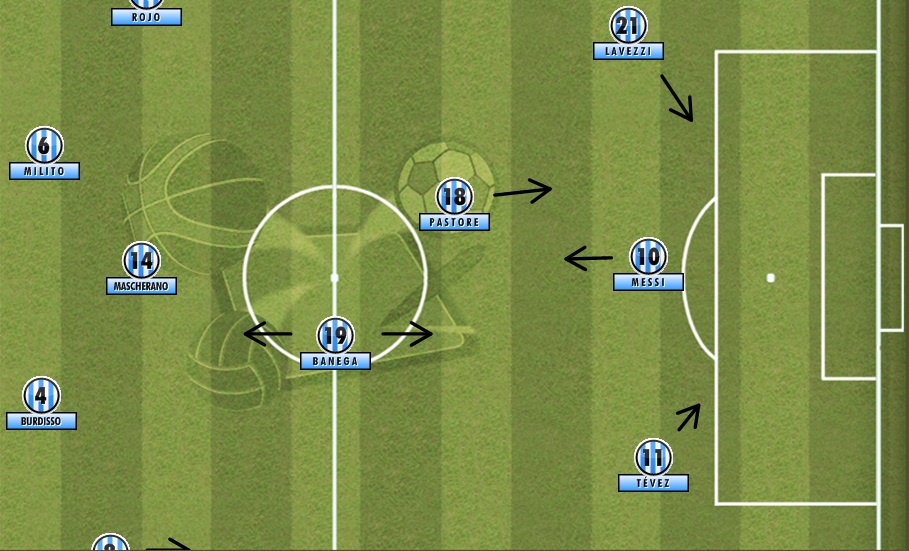
Above you can see Argentina’s primary formation. The defence sits a lot deeper than Barcelona’s due to the lack of pace of the two centre-backs, and they are protected by team captain Javier Mascherano who sits in front of them. The two full-backs, Zanetti and Rojo, provide a service going forward as well in defence, with the former expected to be a little more reserved in going forward.

Valencia’s Éver Banega is the key in the midfield, as he is employed in the all-important ‘Xavi-role’. There are not many players in the world that can do what Xavi does, but with Banega’s slick passing skills and positional discipline, he is certainly a worthy replacement. Alongside Banega, the evergreen Esteban Cambiasso shuttles back and forward in the midfield. Expect to see Cambiasso at both ends of the field, whether it be helping to secure the defence with Mascherano or charging forward to provide Banega with an option to his left. Cambiasso’s positioning also allows Rojo a bit more freedom on the left, as he knows that he will have that extra cover should he get caught out.

Finally the attack, Lionel Messi (no introduction needed) sits in the middle in the much talked-about false nine role, where he drops back in to midfield to link up with Banega. This leaves the two wide players, Lavezzi and Tévez to come inside and provide an attacking threat. These two are probably the key to whether this system will work successfully or not, as it still remains to be seen if they are properly suited to the wide attacker roles in the Barcelona 4-3-3.

Lavezzi is suited to that position, it’s very similar to the one he plays at Napoli and he has impressed greatly in Serie A. Tévez on the other hand, is not particularly accustomed to playing out wide and cutting inside, at Manchester City he plays in a central role, not dissimilar to Messi’s position. El jugador del pueblo is an extremely talented player however, and should be able to adapt as long as he stays motivated.

If things go wrong, or if Batista fancies a change, he is blessed with a wealth of options on his bench and has previously tested some alterations to his system to fit them in. Here are a few examples:

1st option: Javier Pastore

Palermo’s attacking midfielder Javier Pastore has been a little unlucky recently on the national scene, as after a magnificent season in Italy he still cannot seem to hold down a regular place in the Argentina side. This is less to do with Pastore’s performances, and more to do with the fact that his elegant number ten role does not really have a place in Batista’s 4-3-3.

However, Batista would be a fool to leave him out completely, and when he is used (most likely as a substitute for Esteban Cambiasso) Batista switches the midfield to this shape seen below:


As you can see, Pastore is allowed to function in his preferred playmaking role, with Banega taking over the job of shuttling on the right side and Mascherano dropping even deeper in front of the two centre-backs. This will probably be a set-up used in the second half of matches against sides like Colombia or Chile to try and finish the game off, or possibly at moments when the team is looking for a single goal.

2nd option: Gonzalo Higuaín

In a nation where the farewell match of Boca’s lumbering centre forward Martín Palermo overshadowed Vélez Sarsfield becoming national champions, the absence of a big man up front will be one of the first tactical criticisms directed at Batista should something go wrong. In Gonzalo Higuaín, they have a fantastic centre forward, big and strong but also athletic, a much more modern version of the aforementioned San Martín.


Higuaín’s introduction sees an alteration in the attacking three, with Messi moving out to the left and Higuaín taking the central target man role.

All diagrams with help of the fantastic Tactical Pad

Tuesday, 15 February 2011

Copa Libertadores preview

One of the most-watched football tournaments in the world, the group stage of the Copa Libertadores gets properly underway this week. The tournament has the same structure as the UEFA Champions League, in that there are eight groups of four teams, and the top two teams progress to the knockout rounds. In South America, all but two of the opening group games will take place this week, with Fluminense x Argentinos Juniors played last week (a 2-2 draw), and Independiente x Peñarol to take place next week.

So with 14 games, 28 teams, 11 nations represented and a stonking 49,000km to be travelled by the away teams, you could be forgiven for feeling a little bit out of your depth. However, have no fear, as we preview all of this week's action, game-by-game.

Tuesday 15th February

Vélez Sársfield x Caracas
Deportes Tolima x Guaraní
Deportivo Tachira x Santos
San Luis x Libertad
América x Nacional


First up we go to Buenos Aires, where Torneo Apertura runners-up Vélez Sársfield take on the 2009/10 Venezuelan champions Caracas. Both teams have just started the 2010/11 season in each of their respective nations, Vélez played out an exciting 2-2 draw with Independiente, while Caracas are 5 games in with a fairly poor 7 points. By all accounts this should be a pretty straighforward win for Vélez, as Caracas are not a team for them to fear, a far-cry from the side that shocked the whole of South America by reaching the quarter finals in 2009.

Next we go north to the west of Colombia, where Deportes Tolima play Guaraní of Paraguay in the Group 7 opener. There has been much talk surrounding Tolima recently, after famously eliminating Brazilian giants Corinthians in the qualifying rounds. It is generally accepted that Corinthians did not take their opponents seriously enough, and were caught off guard by Tolima's high tempo attacking play during the second leg in Ibagué. Los Piajos will have no such element of surprise tonight, as they take on a Guaraní side who will have prepared well for this encounter. It is imperative for each of these sides to take points off each other in this group, as with Cruzeiro and Estudiantes de la Plata widely expected to sail through in first and second spot, every point is absolutely vital for these other two sides.

We stay in the north of the continent for our next game, as the tournament's early favourites Santos begin their campaign with an away trip to Venezuela to take on Deportivo Táchira. Santos have made a good start to the season, sitting in second place in the Campeonato Paulista, while their opponents Táchira are in an interesting position, having already sealed their qualification to next year's group stages by winning the Apertura in Venezuela. O Peixe expect to start with Neymar up front, partered by either Keirrison or the impressive Maikon Leite. It will be Neymar's first appearence for Santos since winning the South American U-20 Championships in Peru. Santos will be looking for three points in what they hope will be a long and successful Libertadores campaign, while Táchira may just be hoping not to lose by several goals.

Finally we go to Mexico for the two late kick-offs, as San Luis host Libertad and América play Nacional in what is undoubtedly the game of the day. One factor in these games is the absolutely huge distances that the away sides have had to travel, Libertad have gone 6,600km from the Paraguayan capital of Asunción, while Nacional have travelled the longest distance anyone will travel in this year's Libertadores, a truly stunning 7,100km from Montevideo. The games themselves should be interesting affairs, Libertad will be aiming to get some points on the board early in Group 1, a group they are expecting to top. In the other match, every single point will be so valuable in Group 3, and with Fluminense and Argentinos Juniors playing out a 2-2 draw in the opening game, either of these sides will be desperate to sit in first place at the end of the week.


Wednesday 16th February

Unión Española x Universidad Católica
Cruzeiro x Estudiantes de la Plata
Emelec x Internacional
Jaguares x Jorge Wilstermann
Once Caldas x Universidad San Martín

Wednesday's action kicks off in Santiago with an all-Chilean affair as Unión Española take on Universidad Católica in Group 4. Although not a traditional rivalry, these two Santiago clubs will both be absolutely desperate for the points in this one. Group 4 looks like an easy win for the previously mentioned Vélez Sársfield, so these teams will regard each other as the direct competition for second place. It promises to be a good game of football, as both of these sides have an attractive, flowing style of play. Unión usually adopt a 4-2-1-3 with Uruguayan playmaker Ligüera pulling the strings behind the front three, while Universidad go for a more "Italian" 4-3-1-2.

Next is the game of the round, and arguably the game of the entire group stage, Cruzeiro x Estudiantes de la Plata. A replay of the 2009 final (Estudiantes ended up winners on that occasion), these are two of the biggest clubs in recent Copa Libertadores history. However Estudiantes will go in to this year's tournament without the coach that presided over their recent success (and the Libertadores win over Cruzeiro in 2009), Alejandro Sabella, who decided to leave his post last month. The shock of Sabella's departure may cause problems for the Argentine champions, however the talented and hard-working squad is still there, and they will be expecting nothing less than victory. I'm expecting a close game in this one, possibly a draw or perhaps Cruzeiro to sneak it by one goal.

While all the fuss is going on in Minas Gerais, the reigning champions Internacional begin their defence of the trophy in Group 6 away to Emelec of Ecuador. In preparation for this tournament, Inter have adopted an interesting strategy and are only using their B team in the Campeonato Gaúcho, choosing not to over-work their stars for the Libertadores and the Brasileirão. They should win this game and go on to qualify comfortably from the group, however I do not feel Inter have been anywhere near the same side that won last year's tournament.

After the 2010 success, praise was heaped upon Andres D'Alessandro, Tinga and super-sub Giuliano, while the invaluable play of winger Taison was somewhat overlooked, and he was sold to Metalist Kharkiv in the Ukraine. Since then, Inter have suffered from "possession without penetration" without a pacey, direct player like Taison. This frailty was exposed to the whole world in December, where they failed to make possession count and fell to TP Mazembe in the World Club Cup. In the recent transfer window, they neglected to replace Taison with someone of similar attributes, opting instead to sign two more Argentines, forward Fernando Cavenaghi and defensive midfielder Mario Bolatti, and Zé Roberto from Vasco. It is my opinion that if Inter try to play the same way as they have since last year, they will really struggle against any organised side. 

The other game in group six kicks off just afterwards, with Jaguares of Mexico hosting Bolivian side Jorge Wilstermann. Both teams are in interesting positions coming in to this year's tournament, the Mexican side have started very poorly in the 2011 Torneo Clausura which puts them in real danger of relegation this year, so they will most likely be focusing on improving their domestic form as opposed to preparing for continental competition. However Jorge Wilstermann are in an even worse position, finishing in last place in the second half of last year and finding themselves relegated to the second tier of Bolivian football. Understandably, Wilster will have their eyes on domestic promotion instead of Libertadores success, though their domestic campaign does not kick-off until June. Poor domestic form aside, Jaguares are clear favourites in this one, expect a good few goals for the home team.

The final game on Wednesday night takes place in Colombia, as Once Caldas take on Peruvian champions Universidad San Martín. This will be an extremely tough match for San Martín, as Once are very hard to beat at the Estadio Palogrande in Manizales, this superb home form being one of the main reasons for their surprise Libertadores success in 2004. San Martín will have a good go at it though, they have very little to lose as they do not exactly have a long history or large numbers of fanatic supporters. Their story is an interesting one, founded in 2004 by the local university (the Universidad San Martín de Porres), they have since won three Peruvian titles in their six short years in operation. They have a small support, mainly just students at the university, and their mascot is a man dressed as a tooth, a homage to the fact that most of their fans are studying dentistry.

Thursday 17th February

Léon de Húanuco x Junior
Grêmio x Oriente Petrolero
Cerro Porteño x Colo-Colo
Godoy Cruz x LDU Quito

Opening Thursday night's matches, we go to Peru with Léon de Húanuco taking on Junior Barranquilla of Colombia in Group 2. This is Léon's first appearence in the Copa Libertadores, after reaching the final of the Peruvian championships this year. Unlike the previously mentioned San Martín, Léon have a good number of fans, and they will be out in force on Thursday night to try and unsettle their Colombian opponents. This is an absolutely key game in Group 2, as with Grêmio expected to run away with the top spot, there are three fairly low-profile sides fighting for the second place. Additionally, this game should be quite an interesting tactical battle, with the home side adopting a 3-4-1-2 against Junior's favoured 4-3-1-2.

The other game in Group 2 kicks off right after, with group favourites Grêmio hosting Bolivian champions Oriente Petrolero. With the sale of their top-scorer Jonas to Valencia at the start of the year, there is definitely a big gap in this Grêmio squad. Also with replacement André Lima misfiring up front, it looks like they may struggle for goals this year. It is expected that Grêmio may find things tough in this year's Copa Libertadores, but they should not have any problems against the refineros from Santa Cruz.

Later we have one of the most important games of the round, one sure to attract a lot of attention from the two nations involves, as Cerro Porteño, the biggest club in Paraguay, take on Colo-Colo, Chile's biggest side. This promises to be a grand spectacle, with La Olla Azulgrana in Asunción bound to be full to the brim. I'm expecting a win for the away side, as they seem to have the better squad at the present time, all that remains to be seen is if they can overcome Cerro's home advantage. Keep an eye out for Colo-Colo's front two, Ezequiel Miralles and Esteban Paredes, a partnership that brings plenty of goals.

The last game of the week sees the Libertadores group stage come to the Argentine province of Mendoza for the first time as Godoy Cruz host Ecuadorian champions LDU Quito. You would be hard pressed to find a tougher game for Godoy Cruz to start their Libertadores story than against veterans and 2008 champions LDU Quito. A very organised and very hard to beat side, Liga de Quito will have their eyes on the trophy this year. At their home ground in Quito they are a huge challenge for any team thanks to their stadium being at such high altitude, and they pride themselves in their fitness and being able to stretch their opponents for the full 90 minutes, in high altitude or not. Godoy Cruz will have a very tough job in this one, but perhaps they can get a slice of beginner's luck.

So that's it! It promises to be a great week of Libertadores action, and hopefully reading this has given you a bit of useful background information. Regarding where to watch the games, in Europe, www.bet365.com will be showing every single Libertadores game this week through their Live Streaming service. It is completely free of charge and all you need to do is register on the site and you can get access to every Libertadores match this season, straight from your computer. For readers in the UK, you will be pleased to hear that the Copa Libertadores will be shown live on TV thanks to the new Premier Sports channel. They will broadcast Cruzeiro x Estudiantes on Wednesday night, check their website for more information. 

Thursday, 3 June 2010

World Cup News

Just a bit of quick-fire World Cup news from the last week or so... Just to keep you up to date.

GROUP A

The hosts South Africa have released their final 23-man squad for the finals, the main surprise being the omission of their all-time record goalscorer Benni McCarthy. The West Ham striker has been struggling for fitness recently and seems to be a bit out of shape, the team may miss his talismanic goalscoring ability, but it was a brave choice to exclude him.

Meanwhile their group rivals France have made a few surprising choices in their squad selection, leaving out Karim Benzema and Patrick Vieira. Les Bleus forward Thierry Henry has also admitted he expects to feature in this World Cup only as a substitute after failing to get a starting place in France's recent friendlies. The Barca striker said that "the most important thing is the team" and that "we're all in this to go as far as we can together."

GROUP B

Argentina boss Diego Maradona has raised a few more questions surrounding his managerial decisions, as he is choosing to go with four natural centre-backs as his defensive line for this year's Finals. Velez Sarsfield star Nicolas Otamendi is expected to be forced to play as a right-back. Maradona also chose to exclude big names like Riquelme, Cambiasso and Javier Zanetti in his squad selection.

Chelsea midfielder John Obi Mikel has been pronounced 'fully fit' and has joined up with the rest of the Nigeria squad. Mikel was feared to be a doubt for his side's opener against Argentina after he underwent knee surgery to repair a torn meniscus. The Super Eagles have also had their departure to South Africa delayed, after their aircraft at Stansted Airport "developed unspecified problems". They do not know yet when they will be flying out, but the Nigerian government are sending a new aircraft from Paris to fly the team.

There has been mixed news for the Korea Republic, with in form striker Lee Dong-Gook managing to regain fitness in time to be included in the final squad. However defender Kwak Tae-Hwi has had to pull out of the squad with a knee injury.

GROUP C

England boss Fabio Capello has announced his final 23-man squad for the finals excluding Leighton Baines and Theo Walcott. Baines was expected to be in the squad as back-up for Ashley Cole at left-back, but that spot has been handed to the relatively untested Stephen Warnock. Walcott's exclusion also comes as a surprise, four years on from his shock inclusion in the 2006 World Cup squad.

Group opponents Slovenia have instilled an interesting mentality ahead of their World Cup campaign. Forward Valter Birsa believes they have "nothing to lose". The striker went on to say that "all we can do now is carry on giving our all and fighting for every ball, like we have up until now". Team captain Robert Koren is also reinforcing the team spirit in the Slovenian camp, saying the team do not have individual stars, but a strong unit as a team.

GROUP D

Before the World Cup there are always injuries to important players, this year there have been few more important than Germany's Michael Ballack. The Chelsea star was injured in his team's FA Cup victory over Portsmouth and will miss the finals. This adds to the existing injury problems for the Germans, with 'keeper Rene Adler missing out, and midfielder Trasch is struggling for fitness.

Australia's final squad selection included one Middlesbrough player, while omitting two others. Boro 'keeper Brad Jones will be on the plane to South Africa, whilst right-back Rhys Williams and former Celtic striker Scott McDonald missed the cut. Manager Pim Verbeek has blamed Middlesbrough directly for Williams' exclusion, saying that he had been carrying an injury and continued to play for the Teeside club through a series of injections. Verbeek said he "could never train fully", and the manager was disappointed to have to exclude him.

Despite looking like a squad to really surprise everyone at the finals, Serbia's poor warm-up form has drawn its critics. The problem got serious in their friendly defeat against New Zealand, as fans rioted in the stands. Defender Nemanja Vidic had to act as the peacemaker, addressing the fans via a microphone in the middle of the field, asking for calm.

Along with the aforementioned injury to Michael Ballack, Group D has suffered another major injury, with Ghana losing star player, and fellow Chelsea midfielder, Michael Essien. Essien has been injured since January, but he was confident of making a return in time for the finals. After much assessment, Ghanaian medical experts said he would not be fit until the end of July.

Group E

The Netherlands have chosen not to pick striker Ruud van Nistelrooy for their campaign in South Africa, throwing his international future into extreme doubt. van Nistelrooy has a fabulous record for the Oranje, scoring 33 times in 64 games.

Former Celtic icon Shunsuke Nakamura has recovered in time from an ankle injury to be fit for Japan's World Cup squad. After missing the friendly defeat against England, it was feared that the player (now at Yokohama Marinos) could miss out on the final squad selection due to injury.

Cameroon star man Samuel Eto'o had threatened to pull out of this year's World Cup, after national legend Roger Milla had criticised his performances for the national team. Eto'o has since been named in the final squad and will be taking part at the Finals, but this latest scandal is one of many which could unsettle a talented Cameroon side.

GROUP F

Giuseppe Rossi and Mattia Cassani were surprise exclusions in what is an otherwise very strong Italy squad. However, Rossi and Cassani had both been expected to make the final squad, with Rossi's place taken by Giampaolo Pazzini of Sampdoria, and Cassani being dropped in favour of extra striker Fabio Quagliarella of Napoli.

GROUP G

On Tuesday 11th May, Brazil coach Dunga announced his seleção, sparking many debates all over the world. First of all, there was no room for fantastistas Ronaldinho and Adriano, after they both failed to impress for the national team in recent times. Secondly, Dunga refused to give in to national pressure and select the Santos duo Paulo Henrique Ganso and Neymar. Thirdly, there was surprise inclusions for Wolfsburg striker Grafite and Flamengo midfielder Kleberson (formerly of Manchester United), and surprise exclusions for AC Milan forward Alexandre Pato and Juventus midfielder Diego.

Now, there are a lot of talking points here, and I'll go through them a bit here instead of writing a new article.

I am very pleased with Dunga's selection. The main way he has chosen his team is by those who have impressed when given the chance for the national team. This explains the exclusions of everyone mentioned there. On the other hand, when called upon by the national team, players like Grafite, Josue, Julio Baptista and Kleberson have really impressed.

However there is one player I'd probably have picked instead. Hernanes of Sao Paulo is a 25 year old defensive midfielder, a truly fantastic player, I've always said he could walk into most squads in Europe. Unlike other prospective picks like Pato and Diego, when Hernanes has been called upon for Brazil (2008 Olympics squad) he has really impressed. So my only change would be Kleberson out, Hernanes in. Feel free to suggest your own changes.

GROUP H

Spain's striker David Villa has said that he will happily play on the wing for the European champions if it means he will get a spot in the starting line up. This follows the news of Fernando Torres' return to fitness and the general consensus that El Nino of Liverpool will get the starting spot up-front. New Barcelona signing Villa says that "the important thing is to play".

Tips for success Chile are sweating over the fitness of their top striker Humberto Suazo. Suazo is suspected to be suffering from a muscle injury, and would prompt significant changes in the Chile system. However some people in the know are putting this down to Coach Marcelo Bielsa's mind-games, trying to get teams to change their strategy to playing a team without Suazo. Such doubters are confident Suazo will not miss any games, should be interesting to see how that plays out...

So that's it for now, just to keep you all up to date on what is happening around the nations. Its only 8 days away, and I'm sure that like me, you can't wait for it to begin.

Wednesday, 24 March 2010

Who's Number One? (Part 1: Leo Messi)

Who is the best player in the world at the moment? It's a question that many football fans will ask, and it can often bring up an interesting debate. However in the past ten years we have had obvious answers to the question of who is the top player in the world, players like Ronaldinho, Zidane and Ronaldo were the easy answers, top players playing at the top of their game.

But now, we've got a much more interesting selection of players to choose between. What I'm wanting to do here is present the arguments for the three players who are, in my opinion, the top three in the world. I'll give a few reasons for each one, let you know who I think is number one, and you can form your own opinions and let me know who you think is the best, or if there is anyone I've missed. I'll split this up into three posts so I can write a substantial amount for each player.

So I'll get started with a certain Argentinian forward I think you may have heard of...

Lionel Messi (FC Barcelona & Argentina)
Date of Birth: 24 June 1987 (age 22)
Place of Birth: Rosario, Argentina
Position: Winger/Striker


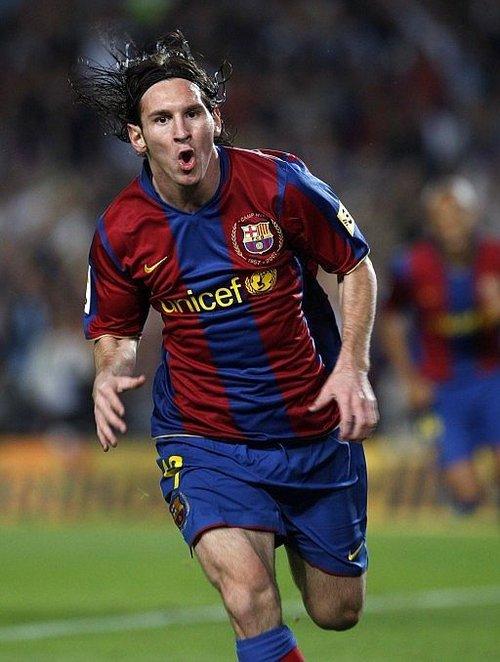
Perhaps the most obvious choice when it comes to the world's best players, Lionel Messi has been astounding football supporters and pundits alike ever since he broke into the Barcelona first team in 2004 at the tender age of 17. As with all young Argentinian stars, Messi was constantly touted as "the next Maradona", and no-one has ever deserved that title more. After some memorable performances and goals (almost too many to mention), and being the current holder of the Ballon d'Or and FIFA World Player of the Year awards, Messi has truly earned his place in this list of the top footballers in the world.

At Barcelona, Messi is in the best team possible to nurture his abilities. He will play as a part of a front 3, often partnered by top players like Zlatan Ibrahimovic, Thierry Henry and Andres Iniesta. It would be hard to define Messi as having one position, he plays in the centre, he plays out wide, he cuts inside, he comes deep to get the ball, he breaks the offside trap, he does EVERYTHING. Messi can steal the show, as he has done so many times, he can win the game with an outstanding solo performance, but his teamwork is something that is often ignored. He has an unbelievable ability to pick out a pass, and his movement off the ball, making space for team-mates, is phenomenal.

Another of Messi's amazing abilities is his balance. This is one of my favourite things about his game, and it isn't really mentioned much. When you watch Messi running at defenders, no matter how tall or powerful these defenders are, it seems like he can never be knocked over. I remember watching last year's Champions League Final against Manchester United, and the only times Messi was on the ground was after he was fouled. At a height of 5'7", and with a pretty slight figure, the way he can keep his balance under pressure from big defenders is nothing short of a miracle.

The current debate regarding Messi is whether he has now surpassed the ability of Maradona in his prime. Because I have been watching Messi all through his professional career, and Maradona's best years were before my time, I would love to say that Messi is now the superior player. Unfortunately I don't think I can say that... Yet. Maradona is often named as the greatest player of all time, and everything I have seen and heard of him he just seemed like a truly special player. Messi is special too, but he is young. Ask me again in three years and I'm hopeful that I would say yes.

Football fans should watch Leo Messi play as much as possible. For me, he is currently the best player in the world. So enough talk about the genius that is Messi, let's allow a bit of his football to do the talking. Here's a nice compilation of some of his best moments, its truly amazing. Watch it right until the end, the best clip is the last one.


So that's it for Leo Messi, tell me what you think of him, is he better than Maradona? Do you think he is overrated? Leave a comment.

Next time I'll be talking about the man who is carrying England's World Cup 2010 hopes on his shoulders. Watch this space.

Monday, 19 October 2009

WC2010: Who's going? (part one)

OK as you may or may not have noticed, I haven't posted much here at all recently. My job isn't really leaving me enough time to write, but after a half-day today due to a server shutdown, I'm here with a new post about the World Cup finals in 2010.

Basically what I want to do over the next wee while, is discuss the teams that have made it so far, pass on a bit of my own knowledge (players to look out for etc.) and basically get some response with people's ideas on who's going to do well, who's going to struggle and all that jazz.

It might take me a while to get through them all, but just bear with me as I'll try to post some other stuff in between. So without further ado, in alphabetical order, let's get on with the show.

ARGENTINA

The Argies have been all over the news recently after just scraping through the qualifying stages, so I won't go in to why that is or anything as you all probably know. Despite the problems though, Argentina still have the quality in their squad that could essentially go all the way. Even though I don't think they will, with the best player in the world (Leo Messi in case you didnt know) and players like Tevez, Aguero and Mascherano in their squad, they can rival any team they come up against in the World Cup.

If Maradona can fashion a proper team out of the talent he has, with a good spine and a team ethic, then yes he could take them to the quarters or semis. Worst case scenario? They draw a tough group and fall at the first hurdle.

Star Man: Lionel Messi

Needs no introduction, been misfiring a little for his country, but the Barcelona forward is still the best player in the world. Expect a decent tournament, but in a team that are underachieving, he will surely be overshadowed by other players in more successful teams.

Player to watch: Nicolas Otamendi


In a nation where every young player is heralded as "the new Maradona", 21-year old centre half Nicolas Otamendi has been tipped to be the long-awaited natural heir to Roberto Ayala. Argentina's main problems are in defence, and with the unexperienced Otamendi being thrown in at the deep end and expected to perform, he has actually coped very well. He has all the qualities of a classic centre-half, and by the time South Africa comes around, I'm tipping him to be one of the best centre halfs in the tournament.


Prediction: Got the team to make the final, but will have to settle for a Quarter Final exit (maybe semis if they get a good draw).

AUSTRALIA

They gave a very good account of themselves at the finals in Germany in 2006. The Socceroos are a nation who have really increased their worldwide standing in the past few years. Australia were always disadvantaged by losing players that qualified to play for Australia through European roots (most notably Christian Vieri, Sasa Ilic etc.) but thanks to their improved reputation, the Socceroos have managed to keep a lot of their home grown talent. Topping their group in the qualifying stage, manager Pim Verbeek has said they are targeting the Quarter Final stage come 2010.

Star Man: Tim Cahill

Again, really doesn't need much introduction. Cahill is a world-class player in a half-decent team, and I can really see him shining in South Africa. With him bossing the midfield, and pitching in with a few goals, he will be a massive player for the Socceroos.

Player to watch: Harry Kewell


Maybe a surprise choice, but I'm guessing the last time you saw Harry Kewell was when he was a fading light coming off the bench once in a blue moon for Liverpool. But now he is playing for Galatasaray in Turkey and he honestly looks like his old self, the fans love him and he is playing some truly great stuff.

He still has a decent kick of pace, a wicked cross, and is a goal threat anywhere around the area. Get ready for a surprise.


Prediction: Their goal is Quarter Finals, in all honesty that's more of a dream than a realistic goal. Group stage exit or scrape through to the Second Round.

BRAZIL

The most successful nation ever to enter the World Cup are at it again. I'm saying it right now that I think Brazil will win this tournament. Dunga has done a great job with the team, but with the abundance of talent they have, they couldn't really go far wrong. Demolishing Argentina earlier in the qualifying, Brazil sealed their ticket to South Africa early on. I don't really know what else I can say about them, they'll win.

Star Man: Luis Fabiano

One of the top goalscorers in the world right now. I was never that much of a fan of him in the past, his attitude was pathetic but he's sorted himself out and is playing some unbeleivable football. Stick your house on Fabiano taking the Golden Shoe.

Player to watch: Nilmar

As if having Luis Fabiano leading the line wasn't enough, Brazil also have the young Nilmar who I expect will get some playing time. A classic striker, he's got a few years before he will be top drawer, but after making his move from the Brazilian league to Villarreal, hes on his way. Oh yeah and he scores goals like this:


Predictions: WINNERS.

CHILE

Maybe a surprise package for South Africa. Finishing second in the South American qualifying, and with wins over Argentina and Paraguay, they do give the impression of a pretty serious team. Haven't really impressed anyone since 1998, no longer having players of the quality of Salas and Zamorano. But now, with some skilful players like Suazo, Fernandez and Valdivia they look like they might be able to turn a few heads.

Star Man: Humberto Suazo

10 goals in the qualifying says it all. He's a proper goalscorer, and with service from the midfield, he should score a few in South Africa. One of those players that confuses me so much. He has scored 140 goals at club level in the last 4 seasons, he's 28, and he's never seeked a move away from South America.

Player to watch: Matias Fernandez

Mati has always been a player with a lot of potential. He gained several supporters in his time at Colo Colo and had a good start to his European football career at Villarreal. However in the seasons following he found some trouble getting a regular starting place and moved to Sporting Lisbon.

He's always looked good for the national team and if he can have a good season Mati could have a decent part to play in the finals.


Prediction: Second Round exit. Although I wouldn't be surprised if they left at the Group stage, or even progressed further with a nice draw.

More later on.

Sunday, 6 September 2009

International weekend part two- 05 September

OK continuing on from last time, two more games to talk about. Cyprus-Republic of Ireland in Group 8 and then the big game in Rosario, Argentina-Brasil.

Cyprus-Eire was a pretty decent game, both teams went for the result right from the start, Kevin Doyle scored early on, Cyprus got one back on the half hour mark through centre-half Marios Elia, and Ireland eventually got the winner through captain Robbie Keane in the last ten minutes.

If I'm
honest I didnt expect Ireland to win it in the end, recently they just haven't seemed like a team who can pull a result out of the bag when they really need it, underlined by the fact their last three qualifiers ended in 1-1 draws. However, in this game they showed good spirit and determination, and to be honest, that's what they need if they are going to make it to South Africa. The introduction of Aiden McGeady was key, also the influence of Robbie Keane really helped them find the winning goal.

OK well it's the other side I wanted to talk about. Cypriot football has advanced so much in the past few years, with Anorthosis reaching the Champions League group stages last year, and APOEL Nicosia doing the same this year. With their league currently thriving, I have high hopes for their national team. All but one of the Cypriot starting 11 on Saturday night, play for teams in the Cypriot league.


Although to be fair, Cyprus don't yet have the squad to compete with teams like the Republic of Ireland, but hopefully as the quality of their league improves, they can gather some proper talent and move forward from there. One of the star performers in the Cyprus squad was left winger Efstathios Aloneftis (pictured). Playing for Omonia Nicosia, the 26 year-old possesses some mean dribbling skills, and a really good cross. He's no spring chicken, but still young enough to do a job for the national side and he could be a useful player for most decent club sides.

Anyway this result kept the status quo in group 8, with Ireland still in second place, one point behind Italy and five ahead of third-placed Bulgaria.

Now onto the big one, Argentina-Brasil. A win in this game would cement a place in South Africa for Brasil and put pressure on Argentina, with Columbia and Ecuador creeping up only two points be
hind them. Brasil eventually came out to win 3-1, a Luisao header and two from Luis Fabiano, with Argentina replying with a wondergoal from Napoli midfielder Jesus Datolo.

A few things about this game, for those who watched it, HOW BAD WERE ARGENTINA'S DEFENCE?? Jesus I have honestly seen Partick Thistle defend more securely. The first goal saw Luisao offered a free header (to say it was a free header was an understatement actually, his marker was in a different timezone), the second had Maicon's shot spilled and then finished by Luis Fabiano, the only person to react at all, and the third saw the whole defence ripped apart by a Kaka pass, playing through Fabiano who finished well.

Why did they defend so bad? There are several explanations. Maybe Maradona doesn't know the first thing about defence, but possibly he just picked the wrong players. The centre-back pairing of Otamendi and Dominguez do play together for Velez Sarsfield, but they have only 4 international caps between them, compare this to the centre-back pairing for Brasil, Lucio and Luisao, who have amassed 120 international appearences. Easily could be the problem.

Argentina have some of the best attackers in the world with Messi, Aguero and Tevez, but without a proper spine they will struggle to have any success on the big stage, they may even struggle to make the World Cup in 2010.


Brasil on the other hand, were very impressive. Dunga has them playing some very nice football just now, with a great variety of strength and skill and a system that could beat anyone in the world, proven by their 100% record in their 15 games so far in this qualifying campaign. I am very sure by the time South Africa comes around, Dunga will have built a squad that will have a very very very good chance of winning the World Cup.

Ok well that's me for now. Might post a quick review of all of the qualifying groups soon... I might just wait until after Wednesday though.